Community Services Departmental Committee Quarterly Meeting
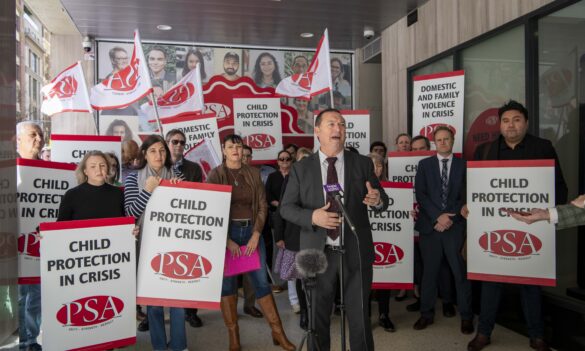
On 29 and 30 August 2024, the PSA Community Services Departmental Committee (DC), your newly elected PSA Delegates met at PSA House to discuss the current ‘Child Protection in Crisis’ campaign and other issues facing members in Child Protection. Below is a summary of the main issues discussed:
The new steering committee was elected and are as follows:
Chair: Sue Nichols – Delegate Ballina
Secretary: Sheldon Sowter – Delegate Helpline
Vice Chair: Tina Huggett – Delegate Hunter Central Coast
Assistant Secretary: Daniel Shorter – Delegate Kempsey
Child Protection in Crisis Campaign
As our members would be aware, the ‘Child Protection in Crisis’ campaign has been ongoing since May 2024. The goal of this campaign has been for the Minns government to:
Recruit another 500 caseworkers
Give child protection workers an immediate and substantial pay rise
Insource Out of Home Care
Due to the lack of action by the Department and the Government to demonstrate that the work being done to support the children and families is valued, your DC Delegates passed the following motion:
“At the Departmental Committee meeting on 30/08/2024, it was agreed that half day strike action would be taken in relation to child protection being in crisis. Members of the Public Service Association pass the motion to take half day strike action due to the lack of action taken by the Department and Government, despite their acknowledgment of the crisis of lack of resources within Child Protection.”
As a result, the half day strike occurred on the 2nd September 2024. This action was taken by members because the child protection system in NSW is in crisis! We can’t attract and retain Caseworkers, we need a pay rise, 500 new Caseworkers more and foster care returned to government hands.
The Departmental Committee will hold a planning day on 9 October to further develop the Child Protection in Crisis campaign. If you have any issues or suggestions to contribute to the campaign, please contact your local Delegates or Departmental Committee Delegates as below;
Flexible Workplace Arrangements
Delegates expressed concern in relation to the inconsistencies across the State, noting that some areas have been directed to return to the office five days a week following the Premier’s circular. Delegates highlighted the workforce is predominantly women and warned that the Department could lose valuable staff if flexibility is not maintained.
Delegates also discussed the importance of encouraging members with disabilities or caring responsibilities to apply for workplace adjustments to ensure they can access flexible working arrangements. The issue of members being unable to work from home due to childcare responsibilities will be brought to the Women’s Council for further discussion.
After Hours Response Team
The After-Hours Response Team (AHRT) has been through great upheaval since March 2024. There has been a cultural review with many recommendations being provided but not yet implemented. The review highlighted many inadequacies of the senior management and its impact on team moral and effectiveness.
Recruitment and retention of Child Protection Staff
Delegates discussed the qualifications required for the Caseworker role. Concerns are held this requirement of tertiary-qualified applicants in the West of the State, where staffing levels are at an all-time low has resulted in some Community Service Centres (CSCs) being non-operational.
Delegates proposed strategies such as creating pathways from universities and establishing cadetships or traineeships. This agenda item will be discussed further in the Community Services workforce workgroup and at the DC planning day on 9 October 2024.
DCJ System reform
The PSA and Delegates will have ongoing consultation meetings with Acting Deputy Secretary Paul O’Reilly for the system reforms that are underway with a focus on policy and practice issues in child protection and OOHC. Paul will attend the November Departmental Committee meeting to provide a briefing and PSA will provide an update to members.
Casework Specialists role change
Written feedback was provided to PSA and consultation is still occurring. There are 72 CWS across the state that are impacted. Since the DC, the Department has responded to the feedback submitted by the PSA. We will keep members informed of developments through separate bulletins.
PSA Industrial bans
A review of the current PSA bans will be reviewed at the upcoming DC planning day in line with the current ‘Child Protection in Crisis’ campaign.
Family Time Worker role update
Recruitment for Family Time Workers (FTWs) is ongoing, with positions advertised and awaiting final approval from DCJ. FTWs will be casual workers with flexible shifts, and support (e.g., interview coaching, first aid, car seat installation training) is being provided.
Workload Planner
Implementation of a new workload planner appears to have stalled. PSA has directions for all members to use the current workload planner to assist members in managing workload and burnout.
Supervision Policy
Delegates discussed the quality and value of individual and group supervision, originally designed for psychosocial group support. Individual Supervision is managerial in nature and concerns held for expertise and training held by management delivery. DCJ does not provide professional supervision however some Districts have employed external professionals to provide individual sessions for psychosocial supervision.
New Mental Health Grant: There is a new grant available. Funding can be requested through the Employee Assistance Program (EAPS) to attend sites.
A big thank you to all of you who attended and participated in this year’s Women’s Conference held on 3 and 4 September at PSA House in Sydney.
It is vitally important that we hear from you all about your experiences at the conference. We value all your opinions, and carefully consider your feedback so next year’s event can be even more rewarding for all who attend.
It would be greatly appreciated if you can please complete the survey below, which should not take more than ten minutes.
Child Protection Workers to Rally in Mt Druitt for Critical Family and Domestic Violence Services
A domestic violence service which saves hundreds of women’s lives a year is one sick day away from closing, unless the NSW Government take urgent action to address a critical staffing shortfall.
The Mt Druitt Family Violence Service provides ‘first contact’ services to women who have just fled violent partners but is so short staffed it might have to close its doors without urgent action.
The unique facility, which has been operating since 2006, provides the most frontline assistance to women who have literally just walked out of violent relationships, like tinned food, feminine hygiene products and the use of a phone so they can arrange to stay at a friend’s place.
The service should have seven case workers, they currently have two, with one trainee.
Former Secretary of the Department of Communities and Justice, Michael Coutts-Trotter, held up the service as the “gold standard” for family violence support provision and a model which should be emulated throughout NSW.
Women who walk into the service have literally just walked out of the most horrifically violent situations, said Stewart Little the General Secretary of the Public Service Association.
“Today a woman who’s just walked out on a violent partner will walk through the door of the Mt Druitt Family Violence Service to use a phone to find a friend’s couch to sleep on, get some tinned food, soap and tampons,” said Mr Little.
“The next day the service will assist with referrals to police, housing and health services, often women will have little ID as they’ve left in a hurry so the service will go to the bank with them so they can access their own money.
“They also help women navigate the family law court system, help them get escaping family violence grants, as well as looking after their immediate basic needs like food, food vouchers, and even clothing because they’ll often leave a violent partner with just the shirt on their back.
“The Mt Druitt Family Violence Service has helped women escaping violence for 18 years, they’ve saved hundreds and hundreds of lives.
“This service is at the front line of helping women escape being punched, bashed or killed in their homes, I’m sorry to use that language but it’s the brutal reality,” said Mr Little.
“They are one sick day away from closure, if one of the few staff that are there had a sick child to look after, or broke an ankle, that would be it, they would have to shut their doors.
“Already when staff have been sick we’ve seen the service have to shut its doors temporarily.
“This service has saved hundreds of lives since it opened, just stop and think about that for a second, this service literally stops women being killed in their own homes, and it might soon close.
“The issue is the Mt Druitt Family Violence Service gets their staff from the Department of Communities and Justice (DCJ) from the pool of child protection caseworkers.
“But the DCJ are so short staffed they can’t release any child protection caseworkers to work for the service, so the potential closure of this service is driven by the chronic shortage of child protection caseworkers.
“When you read in the paper this service has closed, don’t say you weren’t warned,” said Mr Little.
Open now: Expressions of interest to attend PSA CPSU NSW Women’s Conference 2024
The 2024 PSA CPSU NSW Women’s Conference is being held on Tuesday 3 and Wednesday 4 September at PSA House in Sydney.
The Conference will connect women members from across the state and from all employers.
The year’s theme is ‘Inspire Inclusion’.
The Conference is a fantastic opportunity to get new and experienced delegates together to celebrate the achievements of women in the union and all they have done together to build fairer workplaces. We can also reflect on what else we need to fight for to achieve equality.
The conference will give you the tools and the confidence to speak up and make an active contribution to your workplace and get involved in your union.
The Conference is a very popular, so spaces are limited. The PSA CPSU NSW may not be able to offer a place to all who wish to attend. Preference will be given to workplace Delegates.
Expression of interest need to be completed HERE by Friday 12 July 2024.
Further information on the event, including speakers and the agenda will be forthcoming.
PSA CPSU NSW demands for stricter sentencing gets wider support.
Demands for the justice system to take domestic and family violence more seriously has gained support throughout the community and media.
PSA CPSU NSW General Secretary Stewart Little has spoken at length about the issue with Ray Hadley on 2GB radio.
Since the campaign was initially launched by the PSA CPSU NSW, the country was shocked by the death of Forbes woman Molly Ticehurst. The man charged with her murder had been released on bail after serious allegations of domestic violence and sexual assault.
“A woman is killed by a partner or former partner every four days in Australia,” said PSA CPSU NSW President Nicole Jess. “We need to see stricter sentencing, including more custodial terms.”
Sixty per cent of domestic and family violence offenders in NSW receive community orders rather than incarceration. Most of these orders are unsupervised.
Ninety per cent of fines for domestic and family violence offences are less than $1000.
“Many of our members work up close with people affected by domestic and family violence,” said Ms Jess. “We have members in the justice system, Community Services, schools and agencies such as Women NSW who witness this crisis firsthand.
“We need to take this seriously.”
Similar sentiments about lenient sentencing for domestic and family violence offenders have been raised in many opinion pages and by influential journalists such as Crikey’s Bernard Keane.
Many commentators have blamed job choice for the gender wage gap. A report shows a different story.
report by think tank e61 has found the gender wage gap is due to a range of factors, not just the jobs women choose.
Many opponents of action to reduce the gender pay gap blame women’s choice of profession for the difference in salaries between male and female employees.
However, the report, Beyond Skills and Occupations: Unpacking Australia’s wage gap, has found women’s preference for lower-paid ‘soft’ professions accounts for only about 20 per cent of the country’s earnings disparity.
“Gender differences in pay within occupations comprise the bulk of the hourly pay gap and do not narrow when
we control for ATAR scores, job tenure, full-time status, and a wide range of other relevant personal characteristics,” reads the report.
“In reality, a broad suite of policies is needed to close the gender pay gap.
“The greatest opportunities for pay convergence lie in targeting the differences in pay between men and women of the same occupation.
Examples of this include targeting women’s access to high-paying firms, and addressing biases in hiring processes and reducing the flexibility penalty for working mothers.”
PSA CPSU NSW Women’s Officer Simone Scalmer echoed the report’s findings, saying they pointed out both state and federal levels of government have work to do.
“Legislators need to ignore some conservative commentators in the media and continue to work on issues such as workplace flexibility, pay equality and superannuation on unpaid parental leave,” she said.
Thank you to all our members who responded to our recent survey on Domestic and Family Violence (DFV). From your responses we learned there are significant gaps in the way DFV leave is managed in the workplace, the way information is shared to employees and the processes in place to support people needing assistance.
The PSA will continue to advocate for improvements in the Governments response to Domestic and Family Violence, within workplaces and also by lobbying them directly.
Last night we attended the Unions NSW Trades and Labor Council Meeting on the issue of Unions Taking Action on Men’s Violence against Women, which was arranged by Unions NSW to coordinate a response from unions to the crisis.
It was acknowledged that unions have a long history in fighting for gender equality and have campaigned tirelessly to improve support for all victims of violence. The PSA has been at the forefront of these campaigns, with historic gains for women members such as the Librarians Pay Equity Case in 2002 and the Schools Pay Equity Case in 2019.
At the meeting the PSA moved a motion that Unions Taking Action on Men’s Violence Against Women be a standing item on the Unions NSW Executive agenda. The PSA will also participate in the Unions NSW working group to develop a strategy in support of our campaign and members will be kept updated.
PSA CPSU NSW Assistant General Secretary Troy Wright will be speaking this Saturday 11 May in support of Cleaners in their fight for safe, secure, family sustaining jobs.
Seven thousand cleaners across NSW work under whole-of-government contracts, cleaning our public schools, police and ambulance stations, TAFE campuses and other state government offices and properties. The use of outsourced, privatised contracts has resulted in low wages, cuts to hours and unsafe workloads. The NSW Government has the opportunity to create thousands of quality jobs in every corner of the state by ending this failed privatisation and employing cleaners directly.
The cleaning workforce is majority women. On the day before Mothers Day, bring your family and friends to the rally and demand a fair go all women working in low-wage jobs.
We encourage PSA and CPSU NSW members to join us in supporting cleaners in their fight.
Nominations are called for positions of Delegate on the Women’s Council Committee.
The call for nominations is as listed below:
Electorate
No. of Delegates
ELECTORATE 1 – HIGHER EDUCATION
-Universities
-TAFE
1
1
ELECTORATE 2 – DISABILITY SERVICES
1
ELECTORATE 3 – OTHER NATIONAL SYSTEM EMPLOYERS
1
ELECTORATE 4 – COMMUNITIES and JUSTICE (Community Services) and HEALTH
2
ELECTORATE 5 – COMMUNITIES and JUSTICE (Justice)
4
ELECTORATE 6 – EDUCATION and SCHOOLS
4
ELECTORATE 7 – CUSTOMER SERVICE
2
ELECTORATE 8 – CLIMATE CHANGE, ENERGY, the ENVIRONMENT and WATER
PLANNING, HOUSING and INFRASTRUCTURE
1
1
ELECTORATE 9 – PREMIER AND CABINET and TREASURY
1
ELECTORATE 10 – TRANSPORT and REGIONAL NSW
1
A breakdown of the electorates is available HERE.
Nominations and closing date
Each nomination must be seconded by two other women members in the same group electorate as the nominee. Nominees, nominators and seconders must be financial members of the Association as at 13 April 2024.
Nominations will close on 10 May 2024. Forms must be completed via Survey Monkey by 5:00pm on 10 May 2024.
If there is a ballot, candidates who wish to have a profile available for voters to read should provide a brief statement of 300 words or less stating how they will best represent member’s interests.
Space is provided for this purpose on the form available through Survey Monkey.
Gender-based pay differences are on the rise in the Public Sector.
The statistics make sobering reading: the gender pay gap in the NSW Public Sector increased last year and is at its highest point in a decade.
The Public Service Commission released its Workforce Profile 2023, revealing the pay gap between women and men in the workforce increased by 1.7 per cent to 6.4 per cent.
This is despite the fact women make up 66.5 per cent of Public Sector workers. In the overall NSW labour force, women hold 47.3 per cent of positions.
“The two biggest contributors to female employment in the Public Sector are from the two largest portfolios: Education (76.7 per cent female) and Health (74.5 per cent female),” read the report. “Together they represented just over 50 per cent of the total headcount in the sector in 2023. In contrast, Transport had the lowest female representation of all portfolios (35.2 per cent).”
The report found recruitment of women was mainly in lower salary bands.
“This shows there is work to do in reversing systematic inequality,” said PSA CPSU NSW Women’s Officer Simone Scalmer.
While this is bad news, the situation for women in the private sector is much
The Workplace Gender Equality Agency released its report in February 2024, finding the nationwide wage gap was more than 20 per cent.
“Australia’s total remuneration average gender pay gap is 21.7 per cent’” reads the report. “For every $1 on average a man makes, women earn 78 cents. Over the course of a year, that difference adds up to $26,393. The 21.7 per cent gender pay gap includes base salary, overtime, bonuses and additional payments.”
The report was compiled using data from organisations with more than 100 employees.
A new policy direction will work to rid workplaces of this scourge
All NSW public sector agencies were given a 1 March 2024 deadline to ensure their workplace sexual harassment policies were compliant with the model Sexual Harassment Policy published in 2023 by the Public Service Commission.
A Commissioner Direction was issued at the time requiring that each agency develop its own policy that draws on the sector-wide policy and has provisions that are above the minimum standards set out in the direction. If your agency does not have an updated policy, you can inform the PSA.
The figures still make grim reading. In the past 12 months, almost one in five Australian workers reported experiencing sexual harassment at work.
Safework NSW has launched a new four- year strategy to help workplaces prevent sexual harassment as a WHS issue. The strategy has been developed by the Respect at Work directorate which was formed in response to the Australian Human Rights Commission 2020 Respect@Work report on the high rates of sexual harassment across the nation’s workplaces.
The report called for a need to raise awareness that sexual harassment is a WHS issue, and for a shift from the current reactive model to a proactive approach where employers must take actions to prevent sexual harassment before it occurs.
“The PSA CPSU NSW welcomes the development of this strategy and recommends workplaces take steps to ensure they provide a safe working environment for their employees that is free from sexual harassment,” said the union’s Women’s Officer Simone Scalmer.
“We have been calling for a new approach for some time as reflected in the Workplace Sexual Harassment Charter developed by the Women’s Council.
“If you have concerns relating to sexual harassment you should familiarise yourself with the reporting options for NSW workers as well as contact your union who can provide you with advice and support and help you navigate these options.”
The PSA CPSU NSW welcomes the Federal Labor Party’s announcement to pay superannuation on paid parental leave.
The PSA CPSU NSW welcomes the Federal Labor Party’s announcement to pay superannuation on paid parental leave. “However, we will still maintain our campaign to pay superannuation on unpaid parental leave,” said PSA CPSU NSW Women’s Officer Simone Scalmer. “Superannuation on unpaid parental leave would address a major issue on gender- based inequality, “Too many women are retiring with smaller superannuation balances.”
Superannuation on unpaid parental leave was a major part of the PSA CPSU NSW’s demands to parties and candidates at the 2023 State Election.
In March 2024, the Labor Party said if the Albanese Government was re- elected, its next term would include superannuation on the paid parental leave supplied by the Federal Government.
“Time taken out of the workforce to raise children disproportionately falls on women,” said Ms Scalmer. “We will continue to fight for superannuation balances to be topped up during this time. “It will normalise taking time to get involved with family responsibilities.”