Nominations are called for positions of delegate on the Women’s Council Committee.
The call for nominations is as listed below:
ELECTORATE
NO. OF DELEGATES
ELECTORATE 1 – HIGHER EDUCATION
– Universities
– TAFE
1
1
ELECTORATE 2 – DISABILITY SERVICES
1
ELECTORATE 3 – OTHER NATIONAL SYSTEM EMPLOYERS
1
ELECTORATE 4 – STRONGER COMMUNITIES (FACS and Health)
2
ELECTORATE 5 – STRONGER COMMUNITIES (Justice)
4
ELECTORATE 6 – EDUCATION and SCHOOLS
4
ELECTORATE 7 – CUSTOMER SERVICE
2
ELECTORATE 8 – PLANNING AND ENVIRONMENT & ENTERPRISE, INVESTMENT AND TRADE
2
ELECTORATE 9 – PREMIER CABINET and TREASURY, External to Government Sector
1
ELECTORATE 10 – TRANSPORT AND INFRASTRUCTURE
1
A breakdown of the above electorates is available HERE.
Nominations and closing date
Each nomination must be seconded by two other women members in the same group electorate as the nominee. Nominees, nominators and seconders must be financial members of the Association as at 13 April 2022.
Nominations will close on 11 May 2022. Forms must be completed via Survey Monkey by 5:00pm on 11 May 2022.
If there is a ballot, candidates who wish to have a profile available for voters to read should provide a brief statement of 300 words or less stating how they will best represent members’ interests.
Space is provided for this purpose on the form available through Survey Monkey.
J Campbell
for GR Bensley Deputy Returning Officer
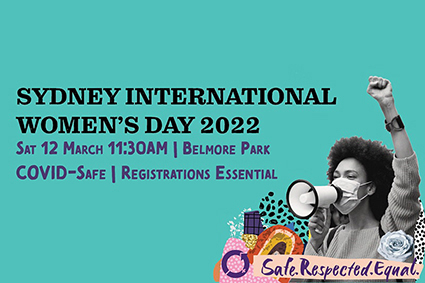
This weekend, we’re celebrating International Women’s Day (IWD) and we’d love you to join us!
Unfortunately, we have had to cancel our march because of the freak weather events in Sydney. However, we are moving the event online.
When 11:30am Saturday, March 12, 2022 Where Please register HERE.
Our theme for IWD the right to be Safe, Respected, and Equal!
We would like to have a focus on helping our sisters in solidarity who have been impacted by these devastating floods.
The member for Lismore, Janelle Safin, will be joining us to let us know what we can do and how we can support them and other flood victims.
Also joining us are Federal MP Tanya Plibersek, ACTU President Michele O’Neill and our President Nicole Jess, who will be presenting the winners of the artwork competition for this year’s IWD.
Nearly 100 years on, we have so much to fight for. Workers are calling to end the gender pay gap, an end to gendered violence at work and at home, and to ensure women are treated with dignity and respect!
Join with your friends and family Bring your workmates to celebrate #IWD2022!
Gender pay gap widens in NSW public sector over past decade – SMH 13/12/2021
General secretary of the Public Service Association union Stewart Little said the public sector should not be seeing a growing pay gap, as the biggest employer in the country with a female-dominated workforce.
“There is no doubt the surge in the pay gap is a direct result of the decision to only pay a 0.3 per cent increase last year, which disproportionately impacted women,” he said.
The PSA argues that gender pay gap will always remain as long as female-dominated sectors like disability, aged care and teachers are chronically undervalued.
In 2019, the union secured a 19 per cent pay increase for school support staff (94 per cent female) after a pay equity case found their work had been historically undervalued.
The National Parks Vocational Branch (NPVB) met at PSA House on 8 November for its Annual General Meeting and to discuss a range of issues affecting PSA members in the National Parks and Wildlife Service (NPWS).
Resourcing of new reserves
Recently more than 500,000 hectares have been added to the NPWS estate with no or extremely minimal resourcing of these lands. On that basis a motion was put to the meeting:
‘that work bans on the new parks be introduced until the department demonstrates provision of adequate resourcing for their establishment and ongoing management’
The motion was passed unanimously. Subsequently a bulletin was distributed for the motion to take effect. The PSA asks that you follow the direction in the bulletin.
Dispute in Industrial Relations Commission regarding vacant, unfunded roles in NPWS
The dispute before the Industrial Relations Commissionhas been discontinued. However, NPWS management has given an undertaking to attempt to fill vacant roles where there are ‘pressure points’. To this end some vacancies have been filled at Scone and Griffith with consideration being given to vacancies at Coonabarabran and Glenn Innes. The Department has also advised if the PSA identified an area that require further resourcing, it will look at redistributing the current resources.
Corporate System
A new reference group has been established on ‘systems of record’ covering AMS; Elements; PWIS and the volunteer management system. Review of these systems (among others) is well overdue. Whilst this group isn’t a decision-making group, it can advise on issues pertaining to such systems with the hope that faults will be rectified. DPIE systems are also failing. A separate group has been convened to advise on SAP HR; Outlook; ArcGIS; CAMMS; Avenza and MS teams.
Women’s issues
In NPWS 51 per cent of employees are women. Key issues identified in a recent PSA surveys include flexible work arrangements; pay equity and mental health and resilience.
ESS Spokeswoman’s Awards for 2021 were announced and congratulations go to Anita Zubovic who won the ‘Courage to Challenge Award’. All four nominees from NPWS were PSA members.
DPIE’s ‘safe’ return to work post-COVID should include special consideration for carers whose level of resilience and energy are low since the pandemic. Also post-COVID return to work arrangements have been inconsistent across the state. They need to be uniformly applied.
Also it is recommended that staff would benefit from ‘trauma informed practice’ training to be able to better deal with the public, stakeholders and each other after this stressful period.
Concern has also been raised in relation to the roll out of a ‘Gender Awareness Module’, citing not enough safety mechanisms in place for participating staff.
Casual vacancies on the NPVB Executive
Despite some casual vacancies on the NPVB Executive being filled, there remained a casual vacancy for a Delegate to represent Aboriginal staff. The PSA/NPVB is pleased to announce that at the AGM this vacancy has been filled by Field Officer Jack Bulger. We welcome Jack and his input to the NPVB Executive.
Visitor Services Officers
A range of issues are currently affecting VSAs including lack of training; having to act as default Rangers; and having to suffer both verbal and physical assaults. The meeting agreed that VSAs should not be undertaking law-enforcement duties without appropriate training. This matter will be pursued by the PSA.
Law enforcement
A working group has been convened to discuss law enforcement matters. Anita Zubovic as PSA representative has been invited to the first meeting of the group. Martin Smith will be the alternate PSA representative if Anita cannot attend the meetings.
Fire Management Advisory Committee
The new online incident payment system has been deemed ‘fit for purpose’ (but yet to be tested in a major fire season). The Fire Management Advisory Committee (FMAC) is no longer interested in pursuing a dedicated fire shirt. FMAC is unhappy with the role out of the fire curtains for vehicles without being consulted. Safety issues include a trial of full faced respirators.
Uniform
The contract for the provision of uniforms to NPWS has been awarded to Stewart and Heaton, which is also the RFS supplier. Full changeover of uniform is planned for March 2022. Four uniforms are being developed for dress; field; office and visitor services. Policy; detailed procedures and code of conduct for wearing of the uniforms is yet to be developed.
One of the elected delegates for Electorate 4 – Stronger Communities (FACS and Health) on the Women’s Council Committee has resigned. This has created a casual vacancy and we are now calling for nominations from financial women members employed in this area to replace that delegate.
NOMINATIONS AND CLOSING DATE:
Each nomination must be seconded by two other women members in the same electorate as the nominee. Nominees, nominators and seconders must be financial members of the Association as at 27 October 2021.
Nominations will close on Friday, 19 November 2021. Forms must be completed via Survey Monkey by 5pm on Friday, 19 November 2021. The ballot will be conducted as per the rules amongst the existing Women’s Council at the next meeting.
If there is a ballot, candidates who wish to have a profile available for voters to read should provide a brief statement of 300 words or less stating how they will best represent members’ interests.
Space is provided for this purpose on the form available through Survey Monkey.
Workplace Research- Flexible Work During the Pandemic
Last year the PSA / CPSU NSW undertook our first ever entire women membership survey into a range of topics that affect women at work and at home. This survey produced the What Women Want Report that is available on our website.
This year we are collaborating with the University of NSW and Central Queensland University Public Service Research Group to enquire into the specifics about how we have worked during the pandemic, looking at issues such as health and safety, workplace flexibility, and work life balance. The researchers are undertaking a survey of public servants from across all state and Commonwealth jurisdictions.
The researchers are required to keep the information they collect confidential and the research findings will be useful to support the union negotiate better working conditions for members in the future.
The National Parks and Wildlife Service (NPWS) Joint Consultative Committee (JCC) met on Wednesday 8 September to discuss a range of issues affecting members in NPWS.
COVID update
Currently DPIE has no intention to introduce mandatory vaccination requirement but may need to reconsider this position consistent with other State Government agencies and Health orders. Consultation will occur with unions prior to any change in position on vaccinations. Rapid Antigen Testing (RAT) has been introduced by the RFS and may apply to NPWS staff entering RFS venues. Currently there’s no plan to do this in the NPWS, unless a RAT test that can be self administered is approved for use. Rules regarding special leave have not changed. Discussion on the NPWS bandwidth ensued. The bandwidth for ALL NPWS employees is 0600-2000 (as per the Parks award).
Vacant roles in NPWS
The PSA and NPWS are currently working through the identified vacant roles in the agency. Advice was given to the PSA that some of the vacant roles have been targeted to be filled and the necessary funding provided to do so. A spreadsheet which identifies the vacancies and their status will be provided to the PSA soon.
The PSA is aware that NPWS has put out a memo on prioritising work as a way of managing the high workloads in NPWS. Work units will be meeting to work through this in the coming weeks. It is positive to see that workload issues are being recognised by NPWS management and systems are being implemented to address this issue. The PSA will monitor progress of this initiative to ensure that it reduces workload stress on our members.
Resourcing of Assets of Intergenerational Significance (AIS) and zero extinctions in NSW National Parks
The meeting was briefed on the identification of over 200 AIS’s and subsequent need to prepare action plans for each asset within 90 days. This new project comes with a significant work load and short timeframes for the preparation of plans (once an AIS is identified and gazetted). The PSA supports this conservation initiative and will be advocating for sufficient staff and financial resources to be allocated to NPWS to achieve this ambitious outcome.
Hunting in NPWS managed flora reserves
There’s been little progress on hunting in flora reserves. An agreement between NPWS and the DPI Hunting Unit is being prepared as well as a risk management plan for NPWS staff working in areas where recreational hunting is permitted. NPWS staff will be authorised under the Forestry Act and an assurance has been given that no NPWS staff will be expected to enter or work in areas where hunting is permitted until the risk management plan is completed and implemented.
Approval and taking of overtime (OT) and Time in Lieu (TIL)
There’s been a number of issues in relation to this matter. Firstly members need to ensure that both overtime and/or TIL is approved by their supervisor first before undertaking additional duties. Secondly it is very clear in the NPWS Award (Section 16.1.2) that overtime/TIL occurs if directed to work longer than 7 hours (NOT after 10 hours OR with the end of your bandwidth which is 0600-2000) ! Your supervisors should know this if not refer them to the relevant section of the award.
Work Health and Safety (WHS)
The DPIE risk controls have now been approved. The draft WHS procedures are on exhibition and hence closed for consultation. The DPIE Health and Well-being Strategy was to be launched and a Memo will be distributed on 22 September.
Twenty three staff nominated as Health and Safety Representatives (HSR’s). Of those 7 have withdrawn their nominations; 11 have been trained – only 5 require training. The PSA also advised NPWS that there were issues with the ongoing functioning of the WHS Committees (some having infrequent meetings and lacking in the taking of meeting minutes).
Internal advertisement of Expressions of Interest (EOI)
The PSA is still questioning why not all internal EOIs are being put on the newly created page on insite. The PSA is advocating that all short term vacancies should be advertised on the Insite web page by to enable statewide coverage for those EOI’s.
Future of non Park Operations fire fighters
The PSA raised issues with staff in Park Programs and Business Delivery maintaining firefighting competency. The NPWS executive is seeking to retain all firefighters in the agency and will send advice to NPWS managers to ensure that there are arrangements in place to ensure that fire trained staff have access to training, PPE and opportunities to maintain their fire line hours.
Processing of incident payment this coming fire season
A new system for processing incident payments was trialled in the 2020/2021 fire season. The system appears to be working. It will continue to be used in the 2021/22 fire season. Staff will be reminded of the online system in the lead up to the fire season.
Women’s priority issues
The PSA asked about the status of the NPWS Diversity and Inclusion Strategy. A one page statement has been prepared. It will be forwarded to all JCC attendees for consideration.
The NPWS has committed to creating a working group to look at WHS issues affecting women. The composition of this group and where it sit will be developed further.
Flexible work Toolkit
It appears that Work From Home (WFH) entitlements are not being applied equitably throughout NPWS. With Park Operations having an inconsistent approach whilst PP and BD have a greater capacity to WFH. The PSA supports flexible work arrangements to be supported by the NPWS. Many of our members, including Rangers have demonstrated during COVID lockdowns that they can work from home. On that basis NPWS needs to be more flexible on the application of WFH entitlements. A meeting will be convened to further discuss the matter.
Farewell to Robert Quirk
The meeting was advised that Robert Quirk will be leaving the NPWS. The meeting wished him well and acknowledged his significant contribution to the NPWS over his many years of service. Rob was also a PSA member for 30 years taking out membership in 1987. The PSA acknowledges and thanks him for his contribution and lengthy membership of the PSA. Rob stated that he felt comfortable leaving NPWS at this point in time with it having a strong Minister who has provided significant funding; resources and support for important conservation work. Rob reminded the meeting of the important and strategic nature of the JCC group.
News from your Women’s Council: things you can do!
COVID-19 continues to present so many challenges to our workplaces. From schools, to prisons, to offices; a lot has changed and is changing for us. But we know from our What Women Want report last year that COVID-19 also presents opportunities for us as women and as unionists that we are all working together to achieve. At out Women’s Council last week, we discussed a few things we can do together to improve our communities, our jobs and change things for women, even if we are in lockdown.
BreastScreen: sign the petition
The pandemic isn’t a good reason to stop vital preventative care for the women of NSW. Our health system, like all our public services, should be funded to look after everyone properly. That’s why removing vital early detection from women is such a poor decision, and we are joining thousands of people in calling on the Health Minister to reverse this decision. Join us here:
Please share the petition on social media, with your work networks, with your family and friends.
Dress for Success: help women in need
Dress for Success has launched its community hub to get more fundraising done for women in need. Dress for Success is a great example of practical solidarity, ensuring women are well presented and able to get to interviews and back to work in locations all over NSW. The new hub includes ways to fundraise online, together with your friends, or even run a virtual marathon. You can sign up here:
Please have a look at the new hub, sign up, and consider holding an online event in your workplace to support Dress for Success. Maybe even get a team together for your virtual marathon!
Nowhere to Go: help our sisters at the ETU
Women in Electrical Trades deals with many of the issues faced by our women members in male-dominated occupations, without even the most basic of facilities: a toilet. The ETU is working to change this. Sign the petition here:
The pandemic and associated stressors are a difficult time for many, and women may be particularly vulnerable. Your union has a range of services available, particularly if you need to leave home to go somewhere safe. All state Health Orders permit a person to leave home to go to somewhere safe if required. You can find some of the resources we provided on our Domestic Violence microsite. More resources are available; please contact the MSC for more details.
Know someone who would benefit from union membership? All the women in your workplace will, so forward this email on and invite them to join. There’s never been a better time to make sure your workplace is united. Join the PSA HERE
In unity,
Trish O’Brien
Chair, Women’s Council
Nicole Jess
President, PSA/CPSU NSW Women’s Council Executive
The PSA has received enquiries from members seeking further information on vaccinations and the workplace.
Mandatory vaccinations for certain diseases is not a new industrial development. PSA members in a variety of different occupations have been required to provide evidence of vaccinations against such diseases as Diptheria, Tetanus, Hepatitis B and Tuberculosis for many years.
Lawful and reasonable directions
The NSW Government has issued a circular which provides guidance for Government Sector Agencies regarding COVID-19 vaccinations for their employees. It is available HERE.
A lawful direction is one that is within the scope of employment and involves no unlawfulness. In the context of determining whether a direction to receive a vaccination is reasonable (in the absence of a Health Order), a case-by-case analysis is appropriate, which would include:
Consideration of the nature of the work the relevant employee does;
The availability of vaccines to that person;
Their suitability for any available vaccination;
The risks of transmission associated with the work (including the vulnerability of particular persons they might work with);
How those risks would be reduced by vaccination;
How much time is given to comply with any direction;
Whether costs or losses caused by complying with the direction would be met; and
The amount of community transmission of the virus at the time the direction is issued.
What happens if I refuse?
Keeping in mind that the above matters, members may be asking what can happen if they choose not to comply with such a direction. The simple answer is not complying with a reasonable and lawful direction can lead to disciplinary action. NSW Police is not suggesting this at the moment, and the PSA does not wish to alarm members that this would be the first step that would be taken. However, in terms of possible disciplinary action, we must look to relevant and related industrial decisions.
Unfair dismissal
In a decision handed down in April, the Fair Work Commission (FWC) found it was reasonable for two employers, one operating in the childcare industry and one in the aged-care industry, to implement mandatory flu vaccination policies. The FWC upheld the dismissal of two employees who were sacked for refusing to receive a flu vaccine.
Whether an employer can require employees to be vaccinated will depend on the circumstances of the direction given, including whether mandatory vaccinations are necessary to ensure work health and safety in the workplace, and whether the workplace is considered a high risk setting.
Work health and safety
A Person Conducting a Business or Undertaking (PCBU) has a duty of care to make sure their employees, and other people (including clients), are safe in the workplace.
As with all matters regarding employee safety, sufficient risk assessments must be completed prior to any direction regarding vaccinations. This has been confirmed by the NSW Government Circular, which states that Agencies must perform a risk assessment prior to giving a direction that employees must be vaccinated (and provide proof of vaccination) in the workplace to determine whether mandatory vaccination is lawful and reasonable.
Section 28 of the Work Health and Safety Act 2011 requires workers to:
(c) comply, so far as the worker is reasonably able, with any reasonable instruction that is given by the person conducting the business or undertaking to allow the person to comply with this Act, and
(d) co-operate with any reasonable policy or procedure of the person conducting the business or undertaking relating to health or safety at the workplace that has been notified to workers.
The Act also defines what is reasonably practicable in ensuring health and safety
In this Act, reasonably practicable, in relation to a duty to ensure health and safety, means that which is, or was at a particular time, reasonably able to be done in relation to ensuring health and safety, taking into account and weighing up all relevant matters including—
(a) the likelihood of the hazard or the risk concerned occurring, and
(b) the degree of harm that might result from the hazard or the risk, and
(c) what the person concerned knows, or ought reasonably to know, about—
(i) the hazard or the risk, and
(ii) ways of eliminating or minimising the risk, and
(d) the availability and suitability of ways to eliminate or minimise the risk, and
(e) after assessing the extent of the risk and the available ways of eliminating or minimising the risk, the cost associated with available ways of eliminating or minimising the risk, including whether the cost is grossly disproportionate to the risk.
Medical Exemptions from vaccinations
Some people may have a medical condition for which receiving a COVID-19 vaccination presents a risk to their health. Under the current Public Health Orders, if you have a serious underlying medical condition, and you are issued a medical contraindication certificate from a qualified medical practitioner, you are exempted from the requirement to be vaccinated. You should seek medical advice from a qualified medical practitioner.
The Australian Technical Advisory Group on immunization recommend that pregnant women be routinely offered the Pfizer vaccine at any stage of pregnancy. You can find more information about pregnancy and vaccines HERE.
The failure of the Federal Government to make vaccines available
There can be no doubt the Federal Government has bungled its responsibility to procure and make available the vaccine in a timely manner to Australians. This lack of availability to the vaccine must be considered if directions around mandatory vaccination are given.
Vaccination discussions in the workplace
The PSA understands that mandatory vaccinations remain a divisive issue, and encourages all members to maintain appropriate and respectful behavior when discussing the matter with colleagues, and your union.
We won’t wait: help end workplace sexual harassment
The PSA/CPSU NSW is part of the Australian union movement’s push to end sexual harassment at work.
Every day unions give support to members who have been sexually harassed at work. Two in three women and one in three men have experienced it according to our Australian Unions survey in 2018.
However, there are plans to make our workplaces safer, especially for women. The Australian Human Rights Commission’s landmark Respect@Work report has 55 recommendations to combat sexual harassment.
The Federal Government sat on this report for more than a year, and it took nationwide protests from women all over Australia after the Brittany Higgins case to force it to take even minimal action. There is now a Bill before the Parliament cherry-picking some recommendations, but ignoring the ones that would make the biggest contribution to making women safe at work.
We also know that family and domestic violence is a national crisis, especially during the pandemic. But the Government has refused to support paid Family and Domestic Violence Leave to help a women leave an abusive relationship.
The Vote on the Bill could be as early as tomorrow. The PSA/CPSU NSW urges members to contact Crossbench politicians and the Government now, urging them to vote for all the recommendations of Respect@Work. Our workplaces need:
A clear prohibition on sexual harassment supported by a proper complaints mechanism
A positive duty on employers to take proactive steps to eliminate sexual harassment, rather than just waiting until things go wrong
Ten days’ paid Family and Domestic Violence leave for all Australian workers – to help people leave an abusive relationship.
Click HERE for contact details for key Crossbenchers and Government MPs, plus suggested tweets.
The National Parks Vocational Branch (NPVB) met on Monday 2 August 2021 to discuss a range of issues affecting PSA members in the National Parks and Wildlife Service (NPWS).
Industrial dispute: vacant roles
The PSA lodged a dispute in the Industrial Relations Commission (IRC) last Thursday, as your union has not been provided information on job losses through the Future NPWS restructure and subsequent filling of vacancies. The PSA understands there are around 120 unfilled ongoing roles in the NPWS that have not been provided to the Association.
The information provided by the Department to the IRC was there has been an increase 330 roles since 2019. However, the PSA was quick to point out that this information was misleading, as these 330 roles were temp roles and created by a $400 million stimulus package for new project. They are not ongoing roles. The PSA advised the IRC if the Department has deleted 120 roles, the NPWS should have provided the PSA a Change Management Plan on what roles, classifications and locations were affected.
Chief Commissioner Constant advised if these roles were deleted there needed to be consultation with the PSA.
The Chief Commissioner has stood the matter over until 12 August 2021 and has advised both parties to provide a list of ongoing roles that have been identified as being deleted from the 2018 structures.
DPIE Flex Agreement
The meeting discussed the new draft Department of Planning, Industry and Environment (DPIE) Flex Agreement. The general consensus of the Delegates was that the new agreement is of little benefit to members in NPWS as it does not suite the operational work, nor meet members’ family needs.
The current NPWS Flex Agreement is contained in our Award and cannot be changed without the consent of the PSA. At this point in time we are not seeking to change this agreement.
COVID-safe work arrangements
Such arrangements were discussed at the meeting. It would appear there is a lack of consistency in work arrangements in the different branches of NPWS. Whilst this may be necessary for a range of operational needs, there are still issues with this approach.
Concerns have been raised by members in relation to COVID-safe work arrangements, specifically in relation to the conditions and approval of filming agreements in NPWS. Most recently large film crews have had their filming agreements approved to work in National Parks in the Greater Sydney Branch (GSB) with little consultation with both members and the PSA. This is extremely concerning for the PSA and its members and we are currently in discussion with the Department.
Sexual harassment in the workplace
Claire Pullen from the PSA was present at the meeting to provide a presentation on the PSA’s ‘model clause’ pertaining to sexual harassment in the work place. Ms Pullen indicated that employees have a ‘duty of care’ not just in respect of resolving such issues when they arise but to ensure that all members (particularly women, who are most affected) work in a safe environment. The presentation was well received by the Delegates. Ms Pullen advised that when the model clause is finalised, it will be provided to departments for consideration and adoption.
Further to this, a briefing note will be prepared on other such issues (including WHS women’s issues) for further discussion at our upcoming NPWS Joint Consultative Committee meeting in September. The briefing note will be prepared by Naomi Goosen, the Women’s Representative on the NPVB.
EOIs for new roles
The PSA is calling out the Department on its approach to Expressions of Interest (EOIs) and their distribution. In one word, it’s dodgy to say the least. It would appear that often a small ‘select’ pool of prospective applicants are being provided the opportunity of applying for some EOIs at the discretion of their Director.
This is made apparent by the advice from the Department:
‘All Branches have been ‘encouraged’ to list new internal EOI’s for roles longer than four weeks on the ‘Jobs Board’ on Insite when they become available’.
This permits a ‘captain’s pick’ by Directors, which lacks any semblance of transparency or equity. In spite of numerous representations to the Department on this issue, it continues unabated.
The PSA will continue to vigorously pursue the matter with DPIE. The Department loves to ‘talk the talk’ on equity so let’s see them ‘walk the walk’!
Casual members’ issues (cash floats and secondary employment)
The PSA has disputed with the Department the issue of members taking cash floats home from toll booths in National Parks. Members should be paid to return floats to the local office before returning home.
Due to the effect of COVID-19 on visitation and hence casual shifts in NPWS, members are working fewer hours and shifts. Thus the NPWS may not be the member’s ‘first’ employer.
The PSA has disputed the Department’s position on ‘secondary employment’ for casual staff in the NPWS. This matter is being followed up by the Department. You will be kept informed on this issue.
Shorebird meeting: SCB
The issue of management of the Shorebird project in South Coast Branch (SCB) is ongoing. Due to issues with COVID-19, the most recent meetings on the project have been postponed. However, a further meeting is planned soon with note that the PSA is not satisfied with the Department’s position on this matter.
Staff housing
Issues over who should occupy staff housing are ongoing. The PSA’s position on this matter is that those who occupy such housing do so on the basis of the area’s ‘operational needs’ The process of determining this should be clear and transparent; the PSA will continue discussions with NPWS in relation to this matter.