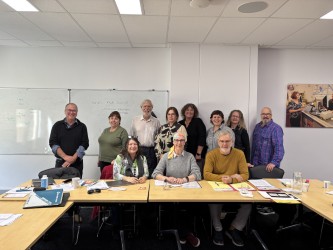
The recent PSA School Administrative Officer (SAO) Science Advisory Group meeting delegates discussed concerns and issues raised by members, as well as ongoing work the PSA and your delegates are undertaking on behalf of SAOs working in science.
(pictured above PSA SAO Science Advisory Group with Dr Phillip Crisp)
In this update
- SAO Science Classification update
- Guest speaker – Dr Phillip Crisp (Risk Assess)
- Chemical safety in Schools
- Fire extinguisher training
- WHS concerns and the importance of reporting
- Your SAO Science Advisory Group delegates and representation
SAO science classification
The SAO Science Advisory Group has advocated for many years for the establishment of a dedicated School Science Technician classification to better recognise the specific duties of the role, training requirements and work health and safety responsibilities associated with Science Laboratory work.
After many years campaigning to have the salary cap removed and reinstatement of an independent umpire, the PSA can now pursue this objective. A claim for a new School Science Technician classification has been included as part of our ongoing interest-based Award discussions with the Department.
While the PSA remains committed to pursuing this claim, members should be aware that the current Award does not expire until November 2027 and, to date, the Department has not provided any meaningful response to the proposal. This remains a long-term objective for the union.
The PSA will continue to pursue improvements in workplace health and safety and professional learning opportunities for SAOs undertaking the specific duties of Science Laboratory and will keep members informed of any developments through future bulletins.
Guest speaker – Dr Phillip Crisp
Dr Phillip Crisp from Risk Assess was invited by the Advisory Group to attend the meeting. He is the author of the original Appendix D of the CSIS package and fielded questions on the Risk Assess program from our group. He explained the benefits of the program but reinforced that it is not a substitute for training and agrees that untrained workers in practical could be a serious work health and safety (WHS) risk.
Chemical Safety in Schools (CSIS)
The Department has sought consultation with the PSA regarding significant updates to the Chemical Safety in Schools (CSIS) resource.
The revised package forms part of the broader Chemical Management Improvement Program (CMIP), which was established following longstanding concerns raised by our PSA SAO Science Advisory Group regarding chemical safety, laboratory practices, training requirements and WHS compliance.
The Department has provided draft consultation material including:
- Draft chemical safety in schools (CSIS) resource;
- Annual chemical safety checklists;
- Hazard identification, risk assessment and control (HIRAC) forms;
- Radioactive sources logbook; and a
- Chemical spill kit flowchart.
The PSA is reviewing the material and has circulated the drafts to the Schools Departmental Committee delegates and other relevant Advisory Groups for feedback.
The CMIP Working Group continues to meet on a fortnightly basis and includes representation from both the SAO Science and General Assistant Advisory Groups. The program remains one of the most significant pieces of WHS consultation currently underway within NSW public schools.
Fire extinguisher training
Although fire extinguisher training is not mandatory, it is valuable professional development for staff working in science laboratories.
If your faculty has a fire extinguisher and you would like to receive training, speak with your principal or supervisor about arranging training. You may also be able to include this as part of your Professional Development Plan (PDP).
If you need support, please contact your PSA delegate or local PSA Organiser.
WHS concerns?
If you have concerns about work health and safety in your role or workplace, contact your local Work Health and Safety Advisor for advice on Department requirements and safe work practices.
Reporting concerns helps identify recurring issues, improve guidance and escalate risks where necessary.
Report. Report. Report.
If an incident compromises your safety—or the safety of others—report it.
Remember:
- Health, Safety and Staff Wellbeing (HSSW) encourages incident reporting.
- There is no blame attached to reporting.
- Your Principal, Head Teacher, Business Manager or School Administrative Manager should never discourage you from reporting.
- If you are discouraged from reporting, the PSA wants to know.
- Reporting helps protect all staff.
- Science support roles involve unique hazards that need to be recognised and documented.
- Report near misses as well as actual incidents.
- Do not overlook psychosocial hazards or injuries.
Reporting protects you and your colleagues.
It strengthens the case for improved safety systems and greater recognition of the work performed by SAOs in science.
Department of Education WHS Hotline: 1800 811 523
Your PSA SAO Science Advisory Group Delegates
PSA delegates represent you
Your union represents your interests through Joint Consultative Committee (JCC) meetings with the Department of Education. These meetings provide a regular forum for workplace issues and concerns to be raised and addressed collaboratively.
If you have workplace issues you would like raised at the next JCC or just for the next PSA SAO Science Advisory Group meeting which is 10 November, please contact the Advisory Group delegate in your region.
You can also invite a PSA Organiser or delegate to attend your network meeting or arrange a workplace meeting at your school. Contact for more information.