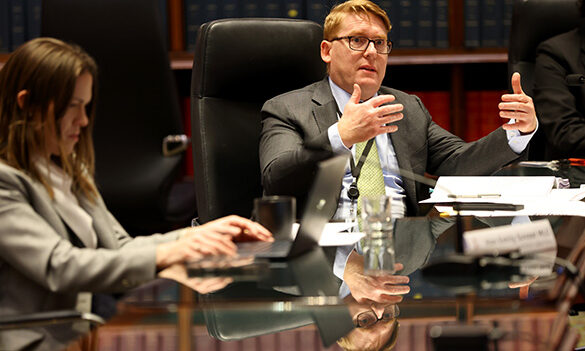
The PSA’s work health and safety dispute concerning Members of Parliament staff was before Deputy President MacDonald of the Industrial Relations Commission (IRC) on Friday 20 November and Tuesday 24 November 2026.
At the hearing on 20 November, Deputy President MacDonald directed the PSA to file written submissions clarifying the nature of the dispute, the basis upon which it had been brought before the Commission, and the orders being sought.
What did the PSA argue?
In its submissions, the PSA argued this is a collective Work, Health and Safety (WHS) dispute concerning inadequate consultation with Members of Parliament staff, rather than a dispute about a single workplace incident or individual worker. The PSA submitted that the Commission has jurisdiction under sections 102B and 102E of the Work Health and Safety Act 2011 to conciliate and, if necessary, arbitrate the dispute.
Your union is seeking a proper consultation framework, including a risk assessment of workplaces, safety procedures and training, and negotiations with the PSA and affected workers to establish an appropriate WHS committee and consultation arrangements.
Who is vicariously liable?
The PSA’s submissions also addressed the unusual and complex employment arrangements applying to Members of Parliament staff. Staff are directly employed by individual Members of Parliament under the Members of Parliamentary Staff Act meaning there are potentially more than 100 individual Persons Conducting a Business or Undertaking (PCBUs) involved. Parliamentary Services also has operational responsibility for Members’ accommodation, including electorate offices. The PSA therefore initially limited the respondents to the two Presiding Officers, while making clear that the application could be amended to include individual parliamentarians if required by the Commission.
The PSA’s case is about the collective safety of Members of Parliament staff and the need for genuine consultation with the workers who are directly affected by WHS risks.
Parliamentary Services’ position
Representatives of the Department of Parliamentary Services (DPS) advised the Commission that they consider the existing WHS Committee and current processes sufficient to address the PSA’s concerns. DPS also advised that Members of Parliament have been consulted and briefed regarding security.
However, the PSA’s position remains that consultation with PCBUs is not a substitute for consultation with workers. Section 47 of the Work Health and Safety Act 2011 requires consultation with workers who are, or are likely to be, directly affected by a work health or safety matter. This obligation is central to the PSA’s dispute.
With a Joint Consultative Committee already scheduled for Monday 30 November, Deputy President MacDonald directed that negotiations take place, including a review of the current WHS Committee and consultation arrangements.
The dispute has been relisted for a report back on 17 December 2026. Importantly, the parties may urgently relist the matter before that date if circumstances require it.
Hours of work and Time Off in Lieu
The PSA has been contacted by members with concerns regarding hours of work, excessive hours and access to Time Off in Lieu (TOIL). It has made initial inquiries and representations regarding how these arrangements operate in practice, including the process for recording and approving TOIL.
Under the Presiding Officer’s Determination, staff ordinarily work 35 hours per week, although Members may require additional hours where it is reasonable and safe to do so. Where staff work more than five additional hours in a week, TOIL may accrue with the Member’s prior approval, up to a maximum of 30 hours. All TOIL accrued and taken must be documented and approved.
Importantly, TOIL is also a work health and safety issue. The Determination provides that TOIL should be granted at the earliest opportunity to allow appropriate rest and recovery following periods of excessive hours. Accrued TOIL must generally be taken within three months, or four months for Legislative Council staff.
No separate overtime payment is available under the Determination.
The PSA will continue to pursue members’ concerns about the practical operation of these arrangements, including whether current processes adequately protect staff from excessive working hours.
Defending your union coverage
The PSA is the union with industrial coverage and representation rights for Members of Parliament staff.
The PSA has separately filed a demarcation dispute concerning the United Services Union’s attempts to recruit employees within the PSA’s established coverage. That matter was also before Deputy President MacDonald on Friday 20 November.
The PSA has been directed to file evidence and submissions addressing the Commission’s jurisdiction by 14 December 2026, with the USU to respond by 16 December 2026. The matter is also relisted for 17 December 2026.
MoPS delegates unanimously respond
Against this background, delegates of the MoPS Vocational Group met urgently on Monday 23 November 2026 and carried the following motion:
That this meeting of delegates to the Members of Parliament Staff Vocational Group condemns the continued actions of the United Services Union (USU) in seeking to recruit employees that are represented by the PSA.
Delegates consider that these actions are creating unnecessary industrial difficulties and undermining the established role of the PSA in representing Members of Parliament staff.
This meeting further notes with serious concern that the Presiding Officers, by permitting these activities to continue, are facilitating attempts by the USU to recruit staff employed by Members of the Legislative Assembly and Members of the Legislative Council in areas where the PSA is the only union that has industrial coverage and representation rights.
The meeting considers that these actions undermine the PSA’s longstanding representation of Members of Parliament staff and the collective interests of PSA members.
Accordingly, this meeting resolves:
- that the USU cease recruitment activity involving employees falling within the PSA’s established coverage;
- that the PSA continues to defend its coverage and representation rights for Members of Parliament staff;
- that the PSA take all appropriate industrial and legal steps available to protect its coverage and the interests of its members; and
- that, should the USU continue to recruit employees within the PSA’s established coverage, the MoPS VG endorse the initiation of lawful industrial action, including appropriate work bans across affected worksites.
What happens next?
The PSA will participate in the negotiations directed by the Commission and will continue pressing for genuine worker consultation, appropriate risk assessment and effective WHS arrangements that protect Members of Parliament staff across their workplaces.
We will also continue to defend the PSA’s longstanding industrial coverage and the collective representation rights of PSA members.
Members will be updated following the JCC on 30 November and as both matters progress towards the Commission report back on 17 December.
PSA contacts
Greg Shaw
Senior Industrial Officer
Claudia Bianchi
Parliament House staff Organiser
Members of Parliament Staff Advisory Group Delegates
Suzette Meade
Chair
David Halliday
Assistant Chair
Angus Hoy
Secretary
Rachel Smoothy
Assistant Secretary
Advisory Group members
Emma-Jane Scott
Joseph Steel
Leeca Higgins
Philippe Desveaux
Parliament House workplace delegates
Abegail Turingan
Riley Duncombe
Jeannie Dougles