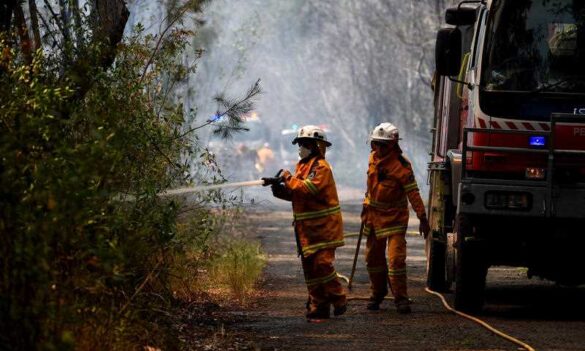
In a sign of what may be a very difficult summer, there are severe fires throughout NSW. Affected members are encouraged to keep track of emergency services alerts and also the RFS website with specific fire information.
The PSA CPSU NSW hopes all members affected areas are safe and well given the current fires. We also wish to extend a big thank you to the emergency services workers, many of whom are your fellow PSA/CPSU members, helping communities affected by fires.
It is an important time to remind all members of the PSA CPSU NSW that your union has award clauses to support all workers unable to attend work in natural emergencies such as bushfire.
Clause 17 of theCrown Employees (Public Service Conditions of Employment) Awardallows public service employees prevented by natural emergency from attending work at a normal work location to apply for varied working hours, alternate working location or to take Family and Carers leave, flex, rec or extended leave or leave without pay to cover the period.
Alternative work locations for those affected by natural disaster can include working from home or from another office or agency.
The award states that, “when a prolonged transport disruption occurs, Department Heads may extend the flexible working hours settlement period during which the transport disruption occurred by a further four weeks, in order to allow employees to make up additional time taken during the disruption”.
Family and Community Services leave can be granted if an employee’s property is threatened by emergencies such as bushfire.
If leave is exhausted as a result of natural disasters, and another emergency arises, the Department Head shall consider applications for additional FACS leave.
Under Clause 40 of the State Water Corporation Agreement, employees of Water NSW also have access to special leave if they are emergency service volunteers.
TAFE NSW employees prevented from attending work at a normal work location by a natural disaster may negotiate an alternative working location or take available FACS leave, flex leave, annual or extended leave, or leave without pay to cover the period concerned.
Additionally, Section 5, Part A of theirEnterprise Agreement allows TAFE employees to apply to vary their working hours.
According to their Enterprise Agreement, “all Forestry Corporation employees are expected to perform any required role in fighting fire that they are competent to perform safely which includes roles that do not involve frontline firefighting”.
Section 56 of the Forestry Corporation agreement stipulates your firefighting duties and hours required, while Section 57 outlines your rates of pay.
Members affected by the fire situations who are unsure of their rights or entitlements or who have a problem with accessing their rights should contact the PSA on 1800 772 679.
As members should be aware the Executive put out a direction to all members that due the changes with Benchmarking, and the deletion of the Assistant Superintendent rank, Senior Correctional Officers will not perform duties that were performed by management positions. This direction was broadcast in April.
On Friday, 10 August 2018 a situation occurred at Shortland Correctional Centre with a Functional Manager attempting to push down responsibilities to Senior Correctional Officer. Members from Shortland rang the Executive and were instructed not to do the duties as it clearly shows on the SAS ROCI that the duties are for a Functional Manager – segregation revocations.
On Monday, 13 August 2018 the PSA were before the Industrial Relation Commission and Commissioner Murphy for a report back on Benchmarking. The PSA was represented by Nicole Jess, Chairperson POVB; David McCauley, Industrial Officer POVB; Michael Jaloussis, PSA Legal representative; Julie Bond, Senior Industrial Officer – Justice; Darren Wells, Chairperson COVB; Guy Simms, Chairperson CAG; and Kylie McKelvie, President PSA and representative Non-Custodial.
Prior to meeting, CSNSW approached David and Nicole in regards to the direction and the incident on 10 August 2018. It was pointed out by CSNSW that any ban on duties meant the consultation on all matters could not take place until a resolution to the ban has taken place. It was pointed out that the ban had been in place since April of this year and had not stopped any consultation process thus far.
The following was discussed with all parties:
If COVB Functional Managers wish to push down their responsibilities to SCOs, then POVB will have no other option than to put in a submission saying, “If SCOs are being made to do the role and function of a Functional Manager then we can do them permanently with a salary increase.” This was not a welcome option for COVB.
On the ROCI it clearly states the following:
O/A – Overall accountable – this means overall accountability to ensure compliance and outcomes
R – Responsible – this means owns the task and outcomes. Accountable for the task being completed to identified standards.
C – Consulted – this means not directly responsible or accountable for task, however consulted with opportunity for input
I – Informed – this means the person should be informed of task being completed.
An allowance for Functional Managers who are on call on weekends.
SCOs in small centres doing the role and functions of a Functional Manager due to their only being one Functional Manager and not compensated appropriately.
SCOs doing greater responsibilities and roles and not being compensated appropriately.
The agreement that was reached at South Coast Correctional Centre that moving forward with all centres going into the final phase of benchmarking will meet with FMs and SCOs to discuss roles and responsibilities to nut out all issues prior to going live.
Lack of communication in centres regarding Changes to issues such as Local Operating Procedures and Post Duties. There seems to be a push to go live in centres prior to all process being completed and staff knowing their requirements to the changes.
Governor and Manager of Security award conditions – working two weekends. CSNSW not complying with this. Some Governors and Managers will continue to work two weekends as per the award.
Concern for the Mental Health of all staff in CSNSW who have had to go through the multiple changes that CSNSW has implemented.
A separate report back with Commissioner Murphy for Non-Custodial as it is difficult to address their issues with Benchmarking at the same time as custodial.
The outcomes that came out of the IRC meeting:
PSA/POVB to lift the ban as per request by Commissioner Murphy.
Meetings to be had in all centres, with Functional Managers and Senior Correctional Officer’s, to discuss roles and functions for all ranks. CSNSW to get back to PSA on a timetable of these meetings.
Commissioner Murphy advised POVB that to do a value added pay claim means that you have to do the tasks to prove the value. PSA to look at this and with the assistance of legal representatives work on a case.
CSNSW to discuss further an allowance for Functional Managers who are on call.
CSNSW to have further assistance in centres to address HR concerns and mental health of staff.
CSNSW to encourage greater communication in centres prior to going live for all staff to be aware of requirements and changes due to benchmarking. Centres should not be going live until Local Operating Procedures and post duties are completed and communicated to staff. Communicated not just through a M drive but changes run through to look at all aspects and to try to alleviate problems that can be foreseen prior to going to live.
Non-Custodial to have their own report back on the morning of 23 October 2018 and Custodial have theirs in the PM.
On Tuesday, 14 August 2018 the POVB Chairperson attended Shortland union meeting and addressed the concerns about roles and functions. The delegates and the Chairperson then met with COVB Executive Secretary Emma Barkley, the Acting MOS and Acting GM.
A meeting will be carried out in Shortland with FMs and SCOs to address roles and responsibilities. At the meeting yesterday several roles were discussed. It was stated again if SCOs are going to do all role that a Functional Manger does we can do a submission. It was encouraging to hear that FMs will not be pushing their duties onto SCOs at Shortland CC.
As of today, Wednesday, 15 August 2018, the PSA Executive will lift the ban that was published in April in regards to SAS and SOC ROCIs. All centres who have not had the meeting with FMs and SCOs, who have gone live and having issues, contact a member of the Executive and we will ask for a meeting at your centre. A representative from the POVB Executive will be present for these meetings.
Centres that are due to go live will have a meeting organised for FMs and SCOs to discuss roles for their centre. There will be a representative from the Executive present for these meetings. We encourage you to start to collate any roles or responsibilities that you think may be raised at the meeting for discussion and forward them to the POVB Executive. We also encourage members to look at the Custodial Operating Policies and Procedures as that is the governing document in regards to responsibilities.
Contact details
If anyone has any questions please contact one of the Executive:
Nicole Jess – Chairperson
0427 609 199
Jason Charlton – Vice Chairperson
0401 500 967
Thor Sutherland – Country Chairperson
0447 633 476
The NSW Government has just issued a tender for a contract to provide ICT services in RMS which requires the successful tenderer to offshore the majority of staff used for the project.
This is a disgraceful attack on the career prospects of ICT professionals in NSW. It seems that the NSW Government would prefer that work in the ICT sector is performed by off-shore workers instead of providing employment and careers to local professionals. This is a direct attack on the Australian IT profession.
The Public Service Association/Professional Officers Association and Unions NSW are fighting to have the tender withdrawn and the provisions regarding off-shoring removed.
We ask all members to write to their NSW MP demanding that the tender be withdrawn. We would encourage you to ask your professional colleagues in both the public and private sectors to do the same.
Below is an example letter, to assist you in composing your own letter:
Dear [name of MP],
I am an IT professional who lives in your electorate. The NSW Department of Roads and Maritime Services has recently drawn up a tender for the provision of IT services which places a cap on the number of local staff, prioritising the off-shoring of the work.
As a voter in NSW, I expect my government to stand up for Australian jobs. IT is a professional field which must be supported and developed in Australia in order to guarantee good jobs both now and in the future.
Would you please advise me of your attitude to this proposal and whether you are prepared to make representations to the Minister, Melinda Pavey, to have the tender withdrawn and to the Premier, Gladys Berejiklian, to commit to supporting Australian IT jobs in future tenders.
To find the name of your NSW MP follow the directions on this website:
The PSA has had regular meetings with NSW Police about re-engineering and ongoing restructuring across the agency.
A PSA Workload Survey in 2017 has been used by your union in raising your concerns with NSW Police, including job security and workload. However, the PSA continues to receive feedback about unsustainable workloads in visits to various NSW Police sites across the state. Re-Engineering appears to have increased members’ concerns about these important issues.
NSW Police has a legislative obligation to ensure your Work Health and Safety, including having appropriate workload levels.
As part of the ongoing effort to protect you in the workplace and push for fair staffing levels, the PSA would like to hear from members in all Commands about workloads.
Please take 5-10 minutes to complete our Workload Survey HERE.
Make sure to pass it on to your colleagues for their responses as well, even if they are not in the union. We need everybody’s feedback!
The survey will close on Friday, 14 September 2018.
For any questions, or to organise a visit to your workplace, please contact:
Roland Harris
PSA Organiser, NSW Police
A union workplace is a fairer workplace – get your colleagues to join the PSA today!
On 8 August 2018, members of the PSA RFS attended the first Women’s Steering Committee teleconference. Issues that pertained particularly to women within this male-dominated industry were addressed, such as issues to do with the OpO policy not being very accommodating to those with families, issues to do with reports into gendered bullying and harassment, as well as office culture.
The PSA is dedicated to stamping out gender inequality within all workplaces, and we are aware that one of the ways to do this is through ensuring that women have a voice, which is the point of this Steering Committee.
In order to run efficiently and effectively, nominations for the Chair and the Secretary are open until 25 September 2018. The role of the Chair of this Committee would be to run the meeting and put together a brief outline of what was discussed that can be given out to all members (similar to this).
The role of the Secretary would be to take notes during the meeting, and ensure that the Minutes were available to all members when asked, as well as circulated to all members of the Committee at the end of each meeting.
If you are not already involved, I would highly suggest that you get involved with the Committee. It’s a really good place to bring up any issues that you are having, especially if you believe them to be because you are a woman.
To get involved, please email . You do have to be a member of the PSA, but if you know any women who are not members and want to be involved, please share this bulletin with them, and ask them to email the above address.
Our next teleconference will be held on 25 September 2018 at 12noon.
In recent visits to Policelink sites, PSA industrial staff have heard feedback from members and delegates about current rostering practices and about the Quality Review process.
Rostering
Initial feedback from some members indicates poor flexibility in full-time and part-time arrangements in terms of number of days worked per week and shift length.
The PSA would like more comprehensive feedback on the days and hours members currently work, as well as the days and hours they would like to work.
Furthermore, the current rostering practices in Policelink with regards to rest days, recurrent leave days (RLDs), and their impacts on fatigue management, seem to be potentially out of step with other shift workers in NSW Police.
Quality Review
The Quality Review process is supposed to be about learning and improvement based on constructive feedback about how you have managed calls and other matters.
However, it seems that this purpose is being sidelined in favour of a more disciplinary focused process.
The PSA would like to hear members’ experiences with the Quality Review process over the last 12 months.
The survey shouldn’t take any more than five minutes and can be completed via the link HERE. All responses will be treated with strict confidentiality and the survey can be completed anonymously.
Please pass on to your colleagues for their responses as well, even if they are not in the union. We need everybody’s feedback!
The survey will close on Friday, 14 September 2018.
A union workplace is a fairer workplace – get your colleagues to join the PSA today!
The PSA has been in consultation with NSW Police about proposed changes at the Firearms Registry.
NSW Police has not provided any change management documentation or details of any structural change. The PSA has raised a number of concerns about the Firearms Registry, including job security and workloads.
The PSA also sought an extension of the temporary contracts that currently expire on 1 September 2018.
The success to date in having contracts extended and staving off further crippling job cuts has come from the collective activity of members on the ground and ongoing support from the PSA.
It is critical this momentum is maintained in the fight for your job security and appropriate staffing levels. This is a big turning point in the way the agency is run and we need every staff member to be involved in the fight for appropriate staffing levels by joining the PSA.
A union workplace is a fairer workplace – what can you do?
Not a member? Get involved by signing up!
Already a member? Get a colleague to join the PSA!
Make sure copies of this bulletin are circulated and put on every noticeboard.
Get more involved by becoming a local union delegate or contact
New members can join online HERE, or by returning a completed application form HERE. They will also be immediately entitled to all PSA membership benefits – please remember the PSA can only represent its members.
Members are invited to contact the PSA if they have any concerns or would like to raise anything confidentially.
Being a union member brings a number of benefits, not only collective action and individual support, but your Award also lists a variety of entitlements that you can have access to as soon as you join up!
Special leave
As a member of the PSA you are entitled to special leave specifically for union business. This is on top of your other leave, such as family leave, study leave and sick leave.
You’re able to attend any accredited WHS courses (which the PSA provides) under the negotiation of local arrangement – this can be done with the help of your union, so just give us a ring if you’re interested, or contact your delegates.
You’re also able to receive up to 12 working days over a period of two years to attend a PSA training course. We have a variety of different ones which may be of interest to you, which you can find HERE.
Advisory Group Delegates
Trustee and Guardian/Office of Public Guardian Advisory Group elections will next take place in the first half of 2019. However, there are a number of current vacancies if any members are interested, particularly in the regions.
If you are an elected delegate to the Advisory Group you are entitled to the following:
Release from duty
If you are to partake in any union business such as:-
Attending WHS Committee meetings
Attending meeting with management (or their representation)
Being a part of an induction meeting
Distributing official union material
Preparation time for all of the above.
You will be released from duty, but regarded to be on duty, so you will still get paid for your time.
Special leave for Delegates
As a Delegate you receive special leave to attend the Annual PSA Conference, meetings with the Advisory Group, Unions NSW and ACTU conferences, to give evidence before any Industrial Tribunal as a witness for the PSA and travel time to all of the above.
Access to facilities
As a delegate you also have access to phone, fax, internet and email facilities, access to the work notice board to post PSA materials, as well as meeting facilities.
Value-added services
A reminder that all PSA members have the following services included in their membership:
Journey Insurance to cover wages of members injured while travelling to or from work.
Personal Accident Insurance to cover permanent disability or death resulting from an accident.
Provident Fund – immediate payment of $3500 to nominated beneficiary in the event of a member’s death.
Union Shopper access giving discounts on a wide range of gift cards (including 5% off at Coles and Woolworths), entertainment, activities, whitegoods, electronics, and more for union members.
Sydney Credit Union (SCU) access giving discounted banking to union members.
And your union fees are tax deductible.
If you have any other questions about your rights and entitlements under the Crown Employees (Public Service Conditions of Employment) Award, or to organise a visit in your workplace, please contact the PSA.
The Parliamentary Inquiry into Emergency Service Agencies has been finalised and the report has been published. The full report is HERE.
This Inquiry was established on 11 May 2017 to inquire into and report on emergency services agencies. The primary purpose of the Inquiry was to consider how certain emergency service agencies respond to bullying, harassment and discrimination. The PSA submission to the Inquiry on behalf of members can be read HERE.
The Inquiry found widespread evidence of serious problems in all agencies. The Chair of the Inquiry committee noted the “committee was shocked by the many cases presented to us and by the seriousness of the allegations, which at times seemed to go unnoticed by the agency itself. It is unacceptable that emergency services workers, who are there to help our communities in times of need, are subjected to such inappropriate behaviours in their day to day work. It is even more disappointing to see that the actions, or should I say inactions, of the agencies in investigating and responding to bullying allegations, have in some cases done nothing but cause further angst and trauma”.
A number of the recommendations from the Inquiry are broad, aimed at changing processes and behaviours across the emergency services sector. There are specific recommendations for the SES to implement, which relate to support mechanisms and policy.
The PSA believes the recommendation for a new organisation to act as an independent, external complaints management oversight body for workplace bullying, harassment and discrimination is a major win for members. This recommendation supports the PSA’s submission that there is no confidence in management’s ability to prevent and resolve workplace bullying, harassment and discrimination.
The PSA would like to thank members who made submissions to the Inquiry. Your delegates and the PSA will ensure that the SES addresses the Inquiry Recommendations in the interest of members.
Further updates
Your union will continue to update members on the developments with your working conditions and will be visiting workplaces to update members.
As always the PSA welcomes member’s feedback. Should you have any questions or comments please contact your delegate first and if required the PSA.
Your NSW SES delegates are:
Michael Langley
Nicole Harding
Tony Day
Craig Ronan
Bernard Kates
Jenelle Owen
Your PSA staff:
Julie-Ann Bond – PSA Industrial Officer
Martin Robinson – PSA Organiser
What can you do?
Give a copy of this bulletin to your colleagues.
Print this bulletin and put it up on your notice board.
The most effective way to voice workplace concerns and progress the interests of employees at Legal Aid is through the PSA.
The PSA has a longstanding relationship with Legal Aid and engages in system of structured consultation with the Legal Aid executive (including the CEO). PSA delegates at Legal Aid play a central role in these processes. PSA delegates and PSA staff advocate for members in a number of forums, the Peak Consultative Committee is the Central structure. More generally, delegates are also involved in dealing with workplace issues across Legal Aid on a collective level and assist members on an individual basis with the support of PSA staff. The Award protects the right of delegates in their duties. The following fact sheet found HERE provides further detail on the role of the delegate.
Delegates are part of the delegates’ committee which holds regular two-monthly meetings. Issues dealt with at these meetings include:
Developing Mental Health & Viewing Disturbing Materials guidelines
The problem of excessive workloads in various units
Work health and safety issues
Surveillance of staff by management
Guidelines for Staff on External Committees and Secondary Employment Guidelines
Prisoners Legal Service Review
Grants Review
Administrative Services Review Prisoners Legal Service Review
EAGP reform changes
Administrative Services Review
Grants Review
Eligibility policy review
Prisoners Legal Service Review
EAGP reform changes
Eligibility policy review
POD review
The PSA encourages interested members to nominate themselves as PSA delegates in the upcoming election. Nominations close on 3 August. The current PSA delegates are:
Head office: Justin Hutchinson
Fairfield: Sarah Ibrahim
Gosford: Christopher Murnane
Burwood: Eileen Peck
Campbelltown: Damien Hennessey
Penrith: Sarah Ellison
Nowra: Sharlene Naismith
Parramatta: Elanor Canning
Please speak to a delegate or PSA staff if you would like further information about being a delegate
The PSA is aware that a number of members across Legal Aid have been told they cannot work outside the hours of 9 to 5 without permission. This not the case and such advice is contrary to purpose of flexible working hours guidelines. Except under special circumstances, under the flexible working hours agreement, you cannot be directed to work only between 9 to 5. Provided there is work for you to complete, you are entitled to remain at work for the full duration of your bandwidth.
The Legal Aid flexible working hours agreement provides the following:
Bandwidth
i. Bandwidth is the period during the day when all officers may record time worked, as provided in this Agreement.
ii. The maximum bandwidth shall be 12 1/2 hours, the earliest starting time being 7.00 am and the latest finishing time being 7.30 pm.
iii. Time shall not be credited to an officer for attendance outside the bandwidth.
Further clause 21 Crown Employees (Conditions of Employment) Award 2009 clearly outlines your right to flexible working hours.
21.1 – The parties to this award are committed to fostering flexible work practices with the intention of providing greater flexibility in dealing with workloads, work deadlines and the balance between work and family life. All parties are committed to managing time worked to prevent any forfeiture of credit hours accumulated under a Flexible Working Hours arrangement.
Other aspects of the agreement to note are:
Part-time staff are entitled to work flexible hours
Members and supervisors should monitor hours worked to ensure staff don’t work too many hours and forfeit any excess credit hours. Members should also ensure they don’t have too great a negative balance and have to take other leave to make up the difference
Working hours can be subject to a guarantee of service – for example members working on a counter can be rostered to start and 9am or finish at 5pm.
Your flexible working hours agreement is available on the Legal Aid intranet.
If you are having trouble in regard to accessing any of the flexible working hours’ conditions, you are encouraged to contact PSA delegates or PSA staff.
Do you want to be a Health and Safety Representative?
In order to safeguard the WHS interests of SHR staff the PSA will soon be lodging a request for the election of Health and Safety Representatives with Justice HR.
What is a Health and Safety Representative (HSR)?
An HSR is a worker elected by their colleagues to represent the work health and safety (WHS) interests of that workgroup as per s68 of the Work Health & Safety Act 2011. They work with the employer in instigating, developing and carrying out measures to ensure WHS at the workplace. This can involve:
developing WHS policies and procedures
reviewing measures taken to address risks
monitoring WHS performance data such as incident and injury reports.
If they have completed the HSR training course, a HSR has the following powers:
Cease Unsafe Work: direct workers to cease unsafe work if there is a serious risk of immediate danger
Provisional Improvement Notices (PIN): issue management with a PIN when there is a safety problem and consultation with the employer has not remedied the problem.
The PSA encourages the elections of HSRs in workplaces as they are a powerful and effective tool in protecting the WHS interests of workers.
How are HSRs elected?
Once workers have requested an HSR election, management have 14 days to commence negotiations with workers around specifics of the HSR structure such as workgroup boundaries and the number of HSRs for each workgroup. HSRs must be democratically elected by workers in an open and transparent election process.
Are you interested in becoming an HSR?
To find out more about becoming a HSR please contact your PSA Delegate in SHR: Jessica Woodruff () or your PSA Organiser: Surabi Alauddin ()